There’s too much of that going around. Picking from a group of providers that may or may not be best for the training project(s) you’re initiating.
It’s not harmful to use a random meme generator, but when eight out of every 10 dollars Pharma spends on commercialization is with outsource providers (TGaS Advisors), we can’t afford random vendor selection.
But, there’s a problem – how to select among those hundreds of agencies, consultants, and training companies? Who can vet all those vendors, and know what they do best?
That’s why you put Impactiviti on your speed dial.
We vet the training vendors, figuring out where they do their best work, and then make targeted recommendations to you. With 21 years of experience in the commercial training industry, we have the knowledge and the contacts you need.
Make one call – it’s free. That’s a whole lot easier than doing internet searches, gathering opinions from colleagues, sitting through capabilities presentations – and then still wondering whether you’ve found the optimal provider.
Set up a Connection Call with Steve Woodruff, and you’ll discover the best-kept secret in the industry – your shortcut to finding ideal partners. We’ll discuss your training needs together, and I’ll make intelligent, targeted (not random!) recommendations.
I have known Steve for many years and worked with him on a number of projects. He has a ton of experience and connections that he is able to leverage to help make your work together successful. Highly recommended! – Director of Training and Past President, LTEN
When you facilitate workshops (or teach, or train, or preach, or….), you have to pull illustrations from wherever you can.
Even a toddler’s bedroom. Let me explain.
People marvel when my wife or I explain how we enforced bedtimes (and wake-up times) with our kids when they were young.
When I explain the simple technique, and the principle behind it (The External Authority), any parents in my Project and Vendor Management workshop start scribbling notes furiously. It may be the most high-impact takeaway in the course!
Here’s what we did – we used THE CLOCK as the authority. When THE CLOCK says it’s 8:00 pm, then it’s bedtime. It’s objective and non-personal, and you can’t argue with Mom and Dad, because the external authority has decreed what the reality must be.
Even better – they weren’t allowed to leave their bedrooms in the morning until THE CLOCK said 7 am.
In this way, we remove any nagging negotiation between parent and child by pointing to something “above” all of us, something that carried with it a sense of inevitability and external authority. How can you argue with the march of time??
(Have young children at home? I know you’re scribbling notes right now!!)
OK – so, what does this have to do with project and vendor management, or any other facet of corporate life?
A great deal.
When projects begin to go off the rails due to miscommunication or scope creep, it’s generally because there hasn’t been a carefully defined and articulated project plan. An agreed-upon project definition, with an agreed-upon process, a defined timeline and budget, and an agreed-upon scope of work.
That project plan is THE CLOCK.
The last thing you want to get into as a project manager is a schoolyard brawl with internal stakeholders or external vendors over what has happened to a going-south-project. The project manager(s) often end up getting the blame in these scenarios. This is prevented is by creating a detailed project plan that everyone consciously agrees to up-front. The plan, and its scope, becomes the external authority, reigning in unauthorized changes and enforcing a level of project discipline on all contributing stakeholders.
Now, it’s not you against them. It’s you and them being accountable to The Plan. Which can only be changed by high-level stakeholders (ultimately) responsible for budget and timing.
You can see how the appeal to an external authority is used all the time in corporate life. Sometimes, with very good effect; other times, as an excuse and evasion of responsibility.
For example – what sounds better: “I’m firing you because I just don’t like you,” or, “According to our manual of company behavior, we’re going to have to let you go because you violated Rule #37b on April 12th.” One of these is strictly personal and can lead to a lawsuit; the other has a whiff of objective inevitability.
Or this: “I tried to herd all the cats, but somehow the project ended up 20% over budget and 3 weeks late,” vs. “The VP of Sales signed off on a change to the original scope in order to include 2 extra videos on August 3rd, which impacted the budget by 20% and pushed back our final deliverable by three weeks.”
Are you involved in managing projects or vendors? Your best friend is detailed definition and up-front agreement. You always want to the clock on your side!
I had T&D Director inquire recently about what kinds of sales force training are most commonly being delivered via the corporate LMS in the commercial pharma industry.
I gave him a quick list, then asked for input from a bunch of my contacts in the Impactiviti “Inner Circle.” So here is our curated list:
1. Plain .pdfs
2. Interactive .pdfs
3. Slideshows
4. Narrated slideshows, perhaps with light video (like Brainshark) (webinars fit here also).
5. Straight videos
6. Low-end eLearning created with authoring tools (scroll-through with narration, minimal interaction, maybe light video, some assessment questions)
7. High-end eLearning created with authoring tools (lots of interaction, some animation, some video, some avatars, certification-level assessment questions)
8. Virtual classroom sessions
9. Low-end simulations (simple branching, inexpensive multimedia)
10. High-end simulations (sophisticated branching, extensive multimedia; more immersive)
:: (just emerging: augmented and artificial reality)
In recent years up to the present, I see most of the activity still happening between #2 – #7 above.
One of the more interesting trends which I see (and heartily approve of!) is delivering more training andothersalesforcecontent through unified-interface interactive apps like Scrimmage* (available via mobile devices), and letting the LMS system be the back-end “black box” for storing training records behind the scenes.
What has been your experience? Any other LMS-delivered/tracked learning modalities that you’re using?
*contact me (AskSteve@impactiviti.com) about Scrimmage if you’re not familiar with it. Great platform.
Looking to identify the best outsource vendors for your needs? Need on-boarding and developmental training on project/vendor management? AskSteve@Impactiviti.com
PLUS: we share a weekly e-newsletter with helpful recommendations and resources for commercial pharma, biotech, and medical device professionals. Click to join:
>> Alexion grabs 3 new patents for its lead drug Soliris – can they keep future biosimilars at bay?
Looking to identify the best outsource vendors for your needs? Need on-boarding and developmental training on project/vendor management? AskSteve@Impactiviti.com
PLUS: we share a weekly e-newsletter with helpful recommendations and resources for commercial pharma, biotech, and medical device professionals. Click to join:
Today’s quick-read news highlights brought to you by Impactiviti:
>> Drug expiration dates: bogus?“Hospitals in the U.S. throw away $800 million worth of unused medicine every year, and pharmacies and consumers trash uncounted millions more, all because they didn’t use or sell those medicines prior to the date printed on the bottle. But according to a new report from ProPublica, most of those drugs are safe and effective for years after the expiration date. And the Food and Drug Administration (FDA) knows it.”
Looking to identify the best outsource vendors for your needs? Need on-boarding and developmental training on project/vendor management? AskSteve@Impactiviti.com
PLUS: we share a weekly e-newsletter with helpful recommendations and resources for commercial pharma, biotech, and medical device professionals. Click to join:
Today’s quick-read news highlights brought to you by Impactiviti:
>> Following the money on opioid prescriptions: “One in 12 doctors has received money from drug companies marketing prescription opioid medications…researchers at Boston Medical Center found that from 2013 to 2015, 68,177 doctors received more than $46 million in payments from drug companies pushing powerful painkillers.”
Looking to identify the best outsource vendors for your needs? Need on-boarding and developmental training on project/vendor management? AskSteve@Impactiviti.com
PLUS: we share a weekly e-newsletter with helpful recommendations and resources for commercial pharma, biotech, and medical device professionals. Click to join:
Didn’t I tell you Nashville was a pretty awesome city? And, judging from the smiles on many faces during last week’s LTEN Conference, I think we all had a good time.
In fact, I’ll be selfish here and put in my vote that we do this conference every year in Music City!
As David Fortanbary put it in his brief tutorial on southern-speak, hopefully we all got “afar” (a fire) lit under us to fuel the rest of this year’s training activities.
The venue, Gaylord Opryland (more a self-contained city than a hotel!), was quite a source of amazement, and I heard regular references to people “getting their steps in” each day without really trying. Not that the exercise was going to reduce any waistlines, because the eating in Nashville – well, if you were there, you know.
There was music, of course – lots of it. And, there was the largest attendance in LTEN history. So all the ingredients were in place for a fantastic conference experience.
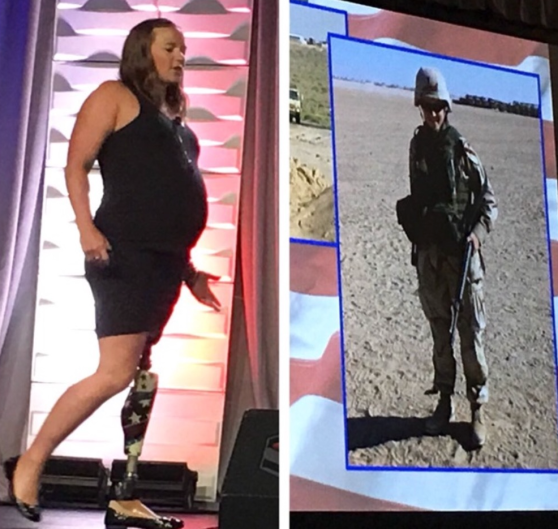
This year, we had three inspirational keynotes – each of them moving in their own way. Melissa Stockwell (Army veteran, Paralympian, and unabashed patriot) told her story about overcoming disability – actually, pushing forward to exceptional victories – after losing a leg to an IED attack in Iraq.
Filmmaker and funnyman Eric Saperston gave a fascinating account of his shoestring voyage across the U.S. in an old VW bus, interviewing successful people and sharing lessons along the way. My favorite quote from him, about his schooling achievements: “I was in the half of the class that made the top half possible.” :>)
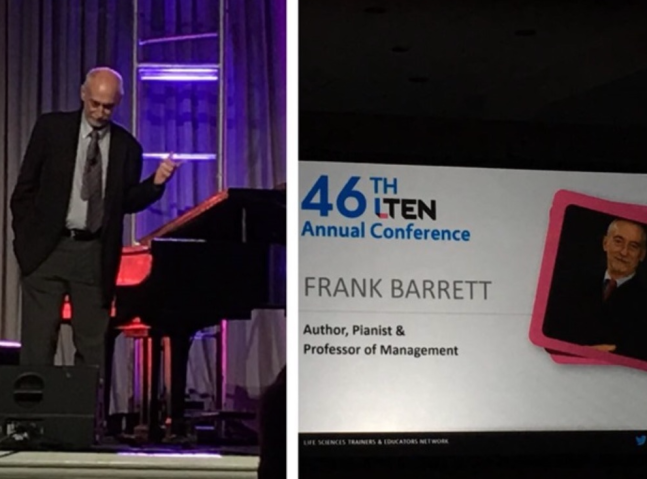
Personally, I was most fascinated by the thought-provoking message of Frank Barrett, who shared vital life lessons that can be extracted from the world of jazz music. As someone who tends to stick to the sheet music, his perspective on learning to improvise, and allow our competency to rise to the surface in a free-flowing environment, was refreshing and challenging.
This year, I want to far fewer workshop sessions than usual – much of my time was spent in one-on-one interactions with both clients and vendor/partners. But I thoroughly enjoyed what the group from Merck (Jennifer Iannetta, Carla Buono, Tyrus Barker, Alina Tudor) presented about their evolving trainer on-boarding program – a topic that is a deep concern of my own.
(in fact, it’s such a concern that I released this video just before the conference. Take 90 seconds and let’s see if we can eliminate Training Project Malpractice!)
There were a number of sessions on global training, a topic of growing concern that I’m glad is being addressed:
(pictured here: Chris Platanos of Alexion; Lindsay Kirsch; Alison Quinn of BMS; Trey Morton of J&J; Jamie Capistrant of Smiths Medical)
On the last day of the conference the popular 15-minute LTEN talks were a great way to wrap up the speaking portion, with excellent and provocative addresses by Will Thalheimer, Rob Toomey, Mark Hood, and Angela Justice (pictured here) who heads up Learning at Biogen.
What about the networking and social events? Excellent, of course. Plenty of good southern food and drink. And lots of time to mingle, including extended times in the exhibit area (aka Learning Village).
There was a great collection of vendor partners in the exhibit hall and, by and large, the feedback I was getting throughout the conference was positive regarding the foot traffic, and the quality of the interactions.
The conference mobile app was well-utilized once again this year, and Mary Myers of Bayer (current President of LTEN) was ever present in the social stream, even when trying to catch dollar bills at the Red Nucleus booth:
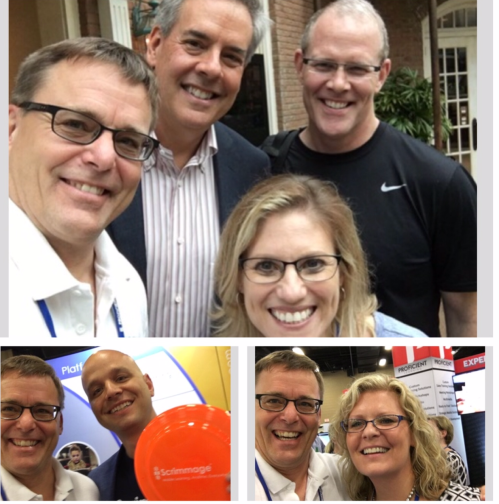
This was my 21st LTEN conference, and one of my favorite aspects is the face-to-face renewal of ties with so many quality professionals who have been in the industry for years. I love brainstorming (and joking around) with the many deeply-experienced vendors who work so hard to provide quality training for our clients. And getting to introduce people to each other is one of my favorite activities throughout the year, but especially at the conference.
(pictured: David Purdy, Garry O’Grady, Sue Iannone, Derek Lundsten, Pam Marinko)
Let’s see, what else? Well, the LTEN staff did a marvelous job orchestrating the event once again. The Best Hugs award definitely goes to Miki White, because – well, she gives awesome hugs (and we hug a lot here in Nashville…). Some of the attendees had the opportunity to go downtown and experience Predator madness, as hockey’s Stanley Cup playoffs were occurring alongside our conference dates. I saw plenty of uploaded pictures of people enjoying Nashville’s lively spread of honky-tonks and restaurants, and I heard more than a few amazed expressions about how friendly everybody is around here.
So, I hope all y’all come back soon. Next year we’re in Phoenix again, but let’s not wait so long to do this again here in Music City!
Impactiviti helps fix all levels of “malpractice” between life sciences trainers and outsource vendors. From providing targeted vendor recommendations, to the unique on-demand Best Practices in Project and Vendor Management workshop, Impactiviti has been the go-to resource in this industry for over 11 years. Steve Woodruff is known as the unofficial Mayor of LTEN.
Specifically, the malpractice that happens when unprepared trainers are put in charge of managing projects and vendors.
You can help me stamp out training malpractice! Here’s how…
By and large, people do not join our training departments with these skills already developed. That’s where Impactiviti comes in.
We set you, and your department, up for success by providing training and consulting services to implement best practices in vendor and project management.
Here are our unique offerings to set your department up for success:
Focused workshop on Best Practices in Vendor and Project Management, imparting the skills and knowledge necessary to transition from field sales, to effective training management and collaboration (coming soon – on-demand eLearning version!)
Targeted vendor recommendations – we talk about your needs, and I identify (through the Impactiviti network) the ideal vendor(s) to consider.
Vendor Optimization/Alignment Consulting – see this post about the benefits of a strategic “reset” of your vendor roster.
So, call me and let’s talk (973-947-7429). There is no charge for discussing your training needs, or for receiving vendor recommendations. I can explain more about how that works when we talk.
If you’re attending the 2017 LTEN Conference in Nashville next week, I have some downloads to suggest to you to make your visit even more productive!
(and, I want to say “hi” while you’re there – scroll down to find out how!)
You definitely want to download the LTEN Conference app – this is your key to on-the-spot updates and networking. Best way to maximize your time at the conference – here are all the directions.
LTEN has launched a SocialLink platform for your networking use year-round. If you’re an LTEN member, login at the l-ten.org website, and go here – sign up at LTEN SocialLink (under Community)
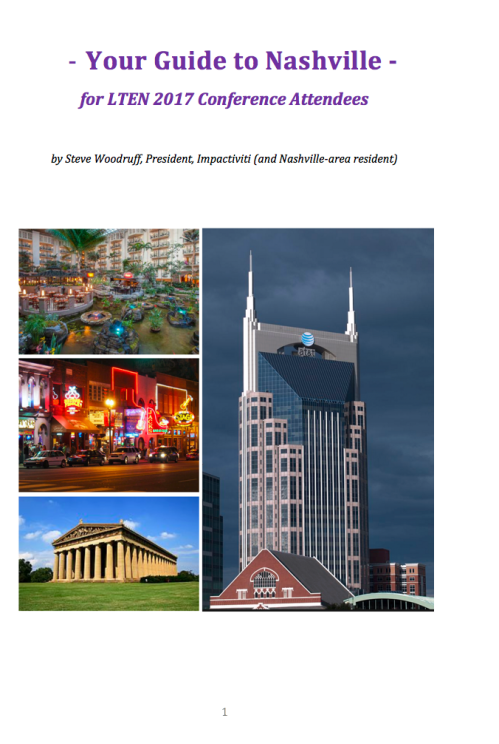
There’s a lot to see and do here in Music City, and if you’re going to have a bit of spare time during your trip, I’ve prepared a little Visitor’s Guide for you to download.
This brief document highlights some suggested places to visit, both downtown and elsewhere. Especially if you’re going to spend one or more free days in town either before or after the event, you definitely want to grab a copy!
Need vendor advice while at the conference? I’ll be your guide! Be sure to say “hi” during the Monday evening reception – to make it easy to find me, I’ll hang out right about here most of the time that night:
Oh, and one more thing – bring lots of your business cards! Over the years, I’ve heard it so many times: “I’ve run out of cards!” There are prize drawings, there are peers you’ll meet, there are vendors you’ll want to keep in touch with. Whatever amount of cards you think you’ll need – double it!
“Steve Woodruff is one of the most “networked” people I’ve found in pharmaceutical training. His communications are always smart and targeted, and I value his professional partnership.” -Jennifer Zinn, Director, Worldwide Marketing, Clinical Laboratory, Ortho Clinical Diagnostics



 Didn’t I tell you Nashville was a pretty awesome city? And, judging from the smiles on many faces during last week’s LTEN Conference, I think we all had a good time.
 The venue, Gaylord Opryland (more a self-contained city than a hotel!), was quite a source of amazement, and I heard regular references to people “getting their steps in” each day without really trying. Not that the exercise was going to reduce any waistlines, because the eating in Nashville – well, if you were there, you know.



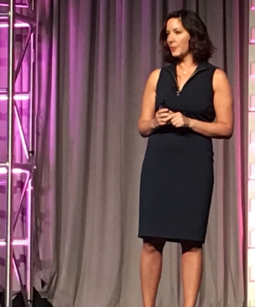 On the last day of the conference the popular 15-minute LTEN talks were a great way to wrap up the speaking portion, with excellent and provocative addresses by Will Thalheimer, Rob Toomey, Mark Hood, and Angela Justice (pictured here) who heads up Learning at Biogen.




 Impactiviti blog